In my Asus RT-BE58 Go Travel Router Review, I mentioned that I was waiting for the UniFi Travel Router (UTR) to come back in stock. Well, I finally got my hands on one.
The UTR retails for US$79 on the US Ubiquiti Store, but it is not yet available on the Singapore Ubiquiti Store. So I got it from TGN Technology for S$149. It comes with a 2-year local warranty.
I self-collected it from their office at 47 Kallang Pudding Road. Alternatively, you can get it from their Shopee store for S$179.
If you are already on UniFi like me, this is the travel router to get.
Specifications
- Wi-Fi Standard: Wi-Fi 5 (IEEE 802.11ac), 2×2 MIMO
- Wi-Fi Speed: Up to 866.7Mbps (5GHz) and 300Mbps (2.4GHz)
- Ports: 2x GbE RJ45, USB-C (Power)
- Uplink: Ethernet, Wi-Fi, USB Tethering (iOS/Android)
- VPN Client: Teleport, WireGuard, OpenVPN
- Display: 1.14-inch status display
- Power: USB-C, 5V/2A (adapter not included), 5W max
- Dimensions: 95.95 x 65 x 12.5mm
- Weight: 89g
Unboxing


- UniFi Travel Router
- 0.5m Braided USB-C To USB-C Cable

There is no power adapter in the box, but it comes with a 50cm braided USB-C-to-USB-C cable. It only needs 5V/2A, so any USB-C charger or even a power bank you are already traveling with will do.

Design
The UTR is small, compact, and lightweight. It is roughly the size of a credit card, and at 12.5mm thick and 89g, it is less than half the weight of the Asus RT-BE58 Go (232g). It slips easily into any pocket of my bag.

The front has a 1.14-inch status display, a nice touch compared to Asus’s single LED.

The factory reset button is on the back. There are no external antennas; both are embedded inside the polycarbonate body.

It has two Gigabit Ethernet ports. The left is for an Ethernet connection to your device, while the right is for the Internet connection.

At the bottom are two USB-C ports: the main one powers the UTR, and the one to the right is a covered USB-C port for your device tethering. To use it, remove the cover. Be careful not to lose the cover as it is tiny.

If you need more range, there is a separate UniFi Travel Router Long-Range (UTR-LR) with a hinged external antenna, but it is thicker. You’ll likely wait a year to get it in Singapore, like the UTR, which was announced last December.
From the side, you can see how thin the UTR is. At 12.5mm, it is about a third of the thickness of the Asus RT-BE58 Go (36mm). There is also a small loop at the corner for you to attach a keychain or lanyard.

Setup
Setup is done through the UniFi iOS app. No UniFi account is required, and it works in stand-alone mode. However, the main draw for me is that it extends my home UniFi network, with my UniFi Cloud Gateway Fiber (UCG-Fiber) at home, and hence you will need a UniFi account to make full use of the UTR.

As mentioned in My Ubiquiti UniFi Setup, I already use Teleport as my VPN, and that is how I will be using the UTR too. Connect the UTR to the hotel Wi-Fi once, turn on Teleport, and every device behind it is tunneled back to my UCG-Fiber at home. No need to manage VPN on each device separately. If you are not on a UniFi gateway, the UTR also supports WireGuard and OpenVPN.

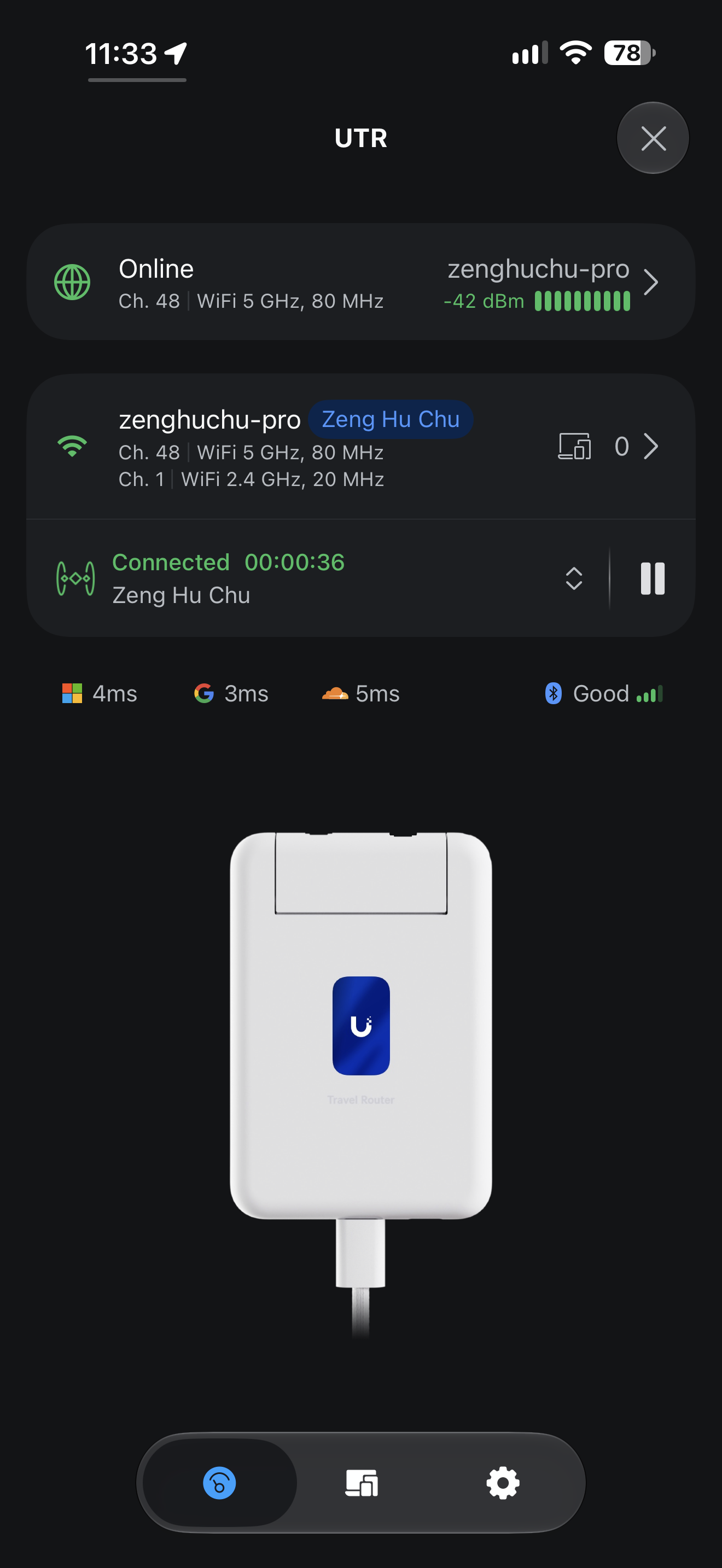
Once Teleport is up, the Home screen shows the Teleport logo with Connected, how long the tunnel has been up, and the site it is connected to, which is my home network. It also shows the upstream Wi-Fi connection, the network the UTR is broadcasting, and the latency to Microsoft, Google, and Cloudflare.
The Devices tab lists every device connected to the UTR, grouped into Wired and Wi-Fi, along with each device’s signal strength.

Once it is online, the status display shows ONLINE, the upstream Wi-Fi network’s signal strength and name, and the number of devices connected to the UTR. No need to open the app to check if it is working.

Wi-Fi 5 Only
My only complaint is that it is Wi-Fi 5 only. In 2026, when even travel routers like the Asus RT-BE58 Go come with Wi-Fi 7, it does feel dated on paper.
Having said that, the 5GHz band tops out at 866.7Mbps. In a hotel where you are lucky to get 50 to 100Mbps from the Wi-Fi, the hotel connection will be the bottleneck long before the UTR is.
My Thoughts
The UTR is not the most powerful travel router you can buy, but it is the smallest and lightest one I have used. If you are already on UniFi, it is a no-brainer, as it plugs straight into your existing setup and Teleport.
If you are not on UniFi, the GL.iNet Beryl 7 is probably the better buy at a slightly higher price (US$129.99), with Wi-Fi 7 and a focus on travel features.


